Leave your details and a comment
We'll contact you to arrange a convenient date and time.
EN
Switching from Section 24: Opportunities, Not Obstacles!
Switching from Section 24 to a work visa is one of the most common—and at the same time most worrying—steps for Ukrainians in Germany. In this article, we look at what to consider, where difficulties most often arise, and how to prepare for a change of status without unnecessary stress.
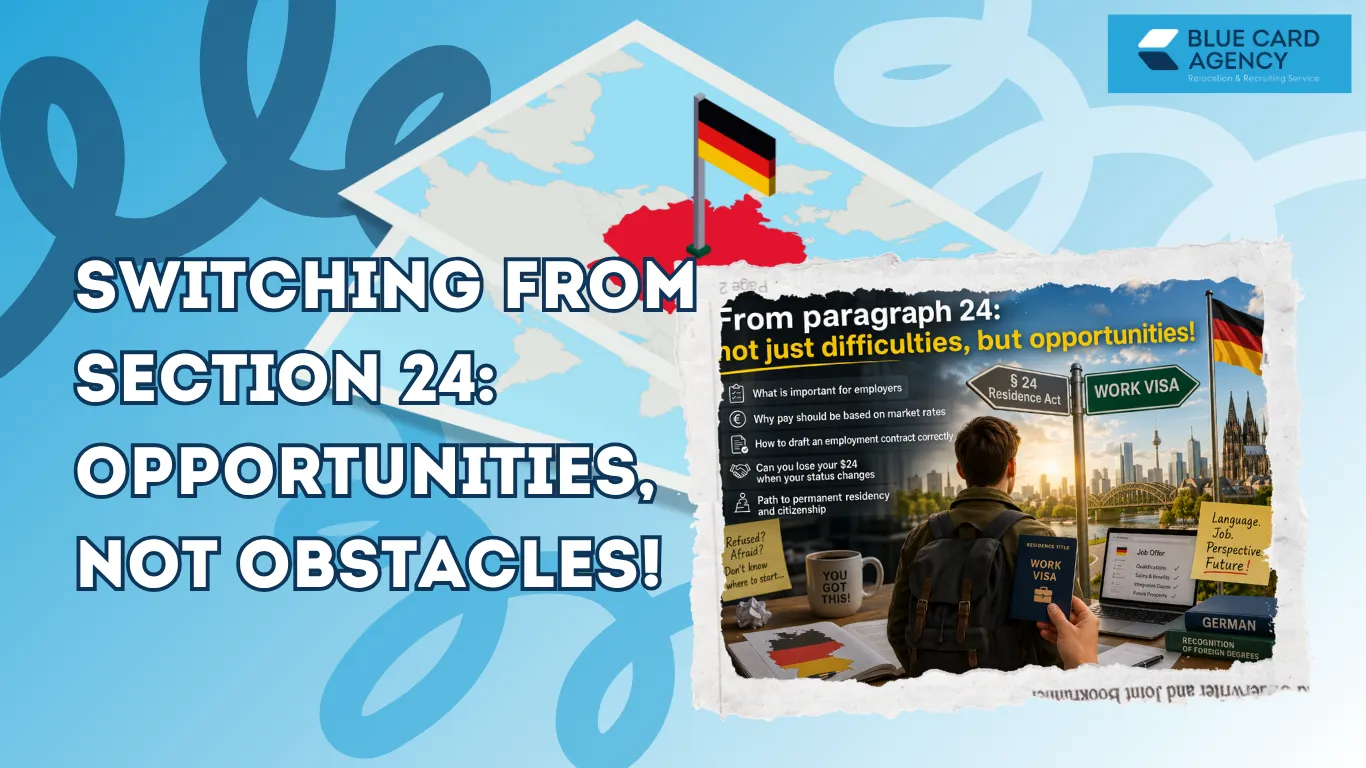
Switching from Section 24 to a Work Visa: Why It Matters
For many Ukrainians in Germany, switching from Section 24 to a work visa sounds daunting: there are too many unknowns, too many fears, and a sense that this path is “not for everyone.” It may seem that without a high salary, perfect German, and a flawless set of documents, it is better not to even try. In reality, however, things are often far less intimidating.
There are indeed many myths surrounding this topic. Some people are convinced that switching to another status is impossible on an ordinary, modest salary. Others believe that the path to a more secure residence permit, permanent residence, or citizenship is closed to them. Some simply put the issue off because they do not know where to begin. Yet in many cases, switching from Section 24 to a work visa in Germany is a perfectly logical next step after settling in, finding employment, and establishing a reasonably stable life in the country.
The topic was discussed in detail during a live broadcast by Blue Card Agency’s managing director and relocation manager, Alexey Kokhvasser, and Michael Bär, a German entrepreneur and employer in the mechanical engineering sector. One of the conversation’s main conclusions was clear: the problem is often not a lack of prospects, but that people underestimate their opportunities, become confused by the requirements, or expect to be rejected before they even apply.
Ukrainians in Germany Are Already Working—and That Is an Important Sign
According to Germany’s Federal Employment Agency, 321,000 Ukrainian nationals were employed in Germany in November 2025, while the employment rate among working-age Ukrainians was 37% . This is a strong figure, showing that Ukrainians are not merely adapting but becoming part of the German labor market.
At the same time, another harmful narrative has emerged: many people have grown accustomed to believing that low pay is normal and that switching from Section 24 to a work-based residence permit is almost unattainable. In practice, these assumptions often become the main internal barrier.
What Employers Look for When Hiring Ukrainians
During the broadcast, Michael Bär emphasized that employers are primarily interested in a person’s qualifications, motivation, and willingness to work. His company employs Germans, Syrians, and Ukrainians—including engineers, technicians, machine setters, and other specialists. In his experience, Ukrainian employees often demonstrate a high level of commitment and readiness to work, which employers value greatly.
This means that Section 24 status alone does not make someone a less attractive candidate. If an employee has experience, relevant skills, and motivation, a German employer may well consider them for positions with significant responsibility.
A degree is not always the deciding factor either. Unless the role is in a strictly regulated profession that requires formally verified education, a license, or a recognized qualification, employers may focus primarily on a candidate’s practical skills and experience.
Why Employers Are Not Always Ready to
Commit to Employees with Section 24 Status
Although Section 24 grants the right to work and allows employers to hire someone quickly without additional restrictions, the status also has a drawback from an employer’s perspective: it is regarded as temporary and less predictable.
When a company hires someone for a long-term position that requires training, retraining, and investment in their integration, the employer needs to know that the person will remain with the team for the long term. Temporary humanitarian status does not always provide that sense of stability.
This is precisely why switching from Section 24 to a work visa benefits not only the foreign national but also the employer. A work-based residence permit creates a clearer outlook for both parties: the employee gains a stable legal basis, while the company can be confident that its investment in training and development is worthwhile.
Wage Dumping: Why Ukrainians Are Often Paid Below Market Rates
One of the most painful issues is the deliberate suppression of wages. In 2022, many Ukrainians arrived in Germany under emergency circumstances and were prepared to accept almost any conditions simply to start working and supporting themselves as quickly as possible.
The market responded quickly: employers gained access to a large pool of qualified and motivated professionals willing to work for less. This created a situation in which many Ukrainians began to regard their low pay as normal.
In Germany, however, there are limits. Even if the law does not set a rigid fixed rate for every occupation, market benchmarks, collective wage agreements, and industry standards still apply. Pay should reflect the employee’s qualifications and the nature of their work.
If an employer pays a qualified professional clearly below the market rate, this can have serious consequences. German practice recognizes the concept of an “unconscionably low wage.” In such a case, the employee has the right to take legal action, while the employer risks a fine, reputational damage, and an obligation to compensate the wage difference for the entire period of employment.
Employer Subsidies: Why They Matter Too
Another important insight from the live broadcast concerns government support for employers. In some cases, a company may receive a subsidy when hiring an employee through the employment agency. This mechanism is used when a new employee needs time to adapt, receive training, and gradually integrate into the company’s processes.
Support may be provided for a period of 6 to 12 months. In practice, 6 months is approved more often, although the period may be longer in some cases. The government may reimburse the employer for up to 50% of the employee’s salary.
This is a useful tool for employers: it allows them to invest in a new employee with greater confidence, knowing that part of the adaptation costs will be reimbursed. There is one important point, however: the employment contract is reviewed when the application is submitted, and an excessively low salary will raise questions with the authority.
Pay that is set too low may result in the subsidy being refused. A market-rate salary is therefore important not only for the employee and the switch to a work visa, but also for an employer seeking government support.
The Main Mistake When Switching: An Incorrect Job Title in the Contract
One of the most common causes of problems when switching from Section 24 to a work visa is not a lack of prospects, but an incorrectly drafted employment contract. Based on Blue Card Agency’s experience, in approximately half of all cases, the job title in the contract is imprecise, overly formal, or does not reflect how it should be worded under German law and the occupational classification system.
The same person performing the same work may be classified on paper either as an unskilled employee or as a qualified professional. This depends on the wording of the job title and the description of their duties.
For example, many Ukrainians work in logistics and delivery as drivers, couriers, or delivery workers. To an employer, these roles may appear to involve similar duties. From the standpoint of occupational classification, however, they may be different positions with different status. If the job title in the contract is incorrect, the role may not pass the assessment as qualified employment. This can put the switch to a work visa at risk.
Why Correcting a Job Title Often Requires a Pay Rise
When the job title in a contract is corrected and aligned with a qualified position, the next question is salary. The employee may previously have been listed in a simpler role and paid at one rate, but after the position is properly redefined, that level of pay may no longer be sufficient.
The Employment Agency assesses the contract as a whole. If the position is considered qualified, the salary must also be in line with the market. Otherwise, the contract may not be approved for the switch to a work-based residence permit.
Switching from Section 24 to a work visa in Germany therefore often requires not only changing the wording of the job title but also reviewing the salary. For an employer, this may be an additional step, but it is precisely what makes the contract a realistic basis for changing status.
Why a Work Visa Benefits Both the Employee and the Employer
If an employer is genuinely interested in an employee and wants to retain them, a logical solution is to issue a new employment contract—for example, a two-year fixed-term contract with the correct job title and a market-rate salary.
For the employee, this means a clear and stable outlook: a work visa and, later, the opportunity to apply for permanent residence and citizenship. It also benefits the employer: when someone stays for the long term, it is easier to invest in them, train them, promote them, and develop them within the team. That is why switching from Section 24 to a work-based residence permit is not only an immigration matter, but also a tool for retaining valuable employees.
Can You Lose Your Section 24 Status by Applying to Switch?
One of the most common fears is that applying for a work visa could mean losing your current status. In practice, there is no need to fear this. Even if the immigration authority or the Employment Agency does not approve the switch, this does not automatically result in the loss of Section 24 status.
The attempt to switch should therefore not be seen as a dangerous step. On the contrary, it is a way to assess your actual prospects and understand whether your current situation is already suitable for a change of status.
Moreover, many people try to retain Section 24 status for as long as possible because it provides social benefits, additional support, and protections that are not available under a standard work-based residence permit.
Can You Switch Directly from Section 24 to Permanent Residence or Citizenship?
No, a direct switch from Section 24 to permanent residence or citizenship is not possible. This is one of the key facts that everyone planning their future in Germany needs to understand. Before applying for permanent residence or naturalization, a person must first switch from humanitarian status to one of the standard types of residence permit. This may be a work visa, a student residence permit, family reunification, a business residence permit, or another option. Anyone who wants to build a long-term life in Germany will therefore need to address the question of changing status sooner or later.
Requirements for Switching from Section 24 to a Work Visa
In general, the following are considered a good starting point:
- full-time employment, usually at least 35 hours per week;
- a qualified position;
- a market-rate salary;
- the ability to fully support yourself and your family;
- at least 2–3 years of professional experience;
- a vocational or university qualification;
- ideally, a recognized degree or at least confirmation that the qualification is comparable.
It is important to understand that having a degree does not guarantee success by itself. At the same time, not having one does not always mean the application will be refused. What matters far more is that the qualifications, position, employment contract, and income level are consistent overall.
What You Can Do Now If You Want to Leave Section 24 Status
Anyone seriously considering switching from Section 24 to a work visa in Germany should begin preparing well in advance. Useful practical steps include:
- learning German;
- having your degree recognized or obtaining confirmation that your qualification is comparable;
- finding qualified employment;
- becoming fully self-supporting;
- completing an integration course;
- passing the “Life in Germany” test.
All of this strengthens the applicant’s position and makes the switch to a work-based residence permit more realistic.
Useful Resources from Blue Card Agency
For those who want to understand whether it is worth starting the process of switching from Section 24 at all, Blue Card Agency has prepared several forms of support.
There is a free Telegram botthat provides an initial assessment of your situation and helps you understand your prospects of changing status.
A detailed webinar is also available on the types of residence permit that can be obtained after Section 24, including study, work, business, family reunification, and other options. It covers real-life examples, requirements, and practical scenarios.
There is also a mini-course for those who already know that a work visa is right for them and want to complete the process independently—from the application form and degree recognition to checking the job title and salary and selecting the correct section of the law.
Read also
-
Which Residence Permits Are Available to Ukrainians Under §24—and Which…
-
-

Finding Accommodation in Berlin and Anmeldung: A Complete Guide for…
-

How to Relocate from UAE and Gulf Countries to Germany:…
-
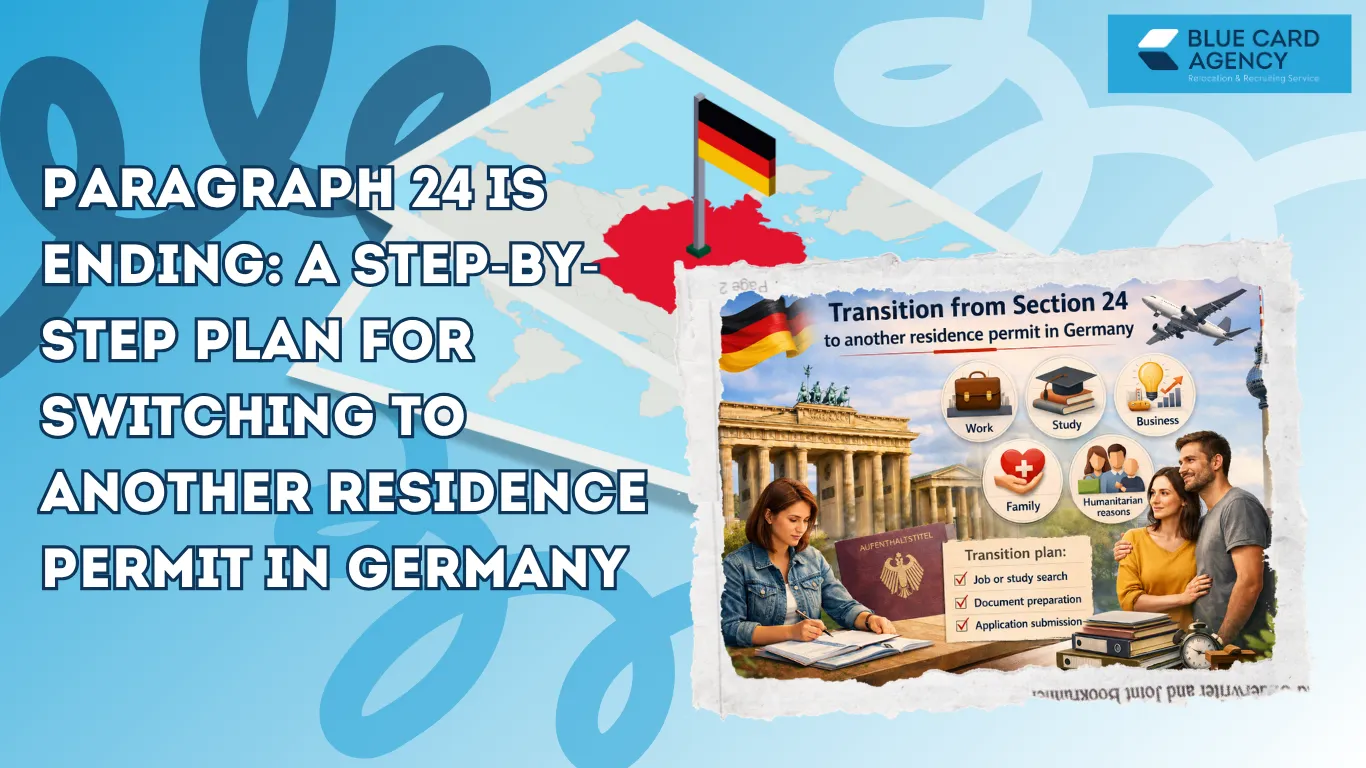
Paragraph 24 is ending: a step-by-step plan for switching to…
-
Mistakes when submitting visa documents and residence permit applications for…


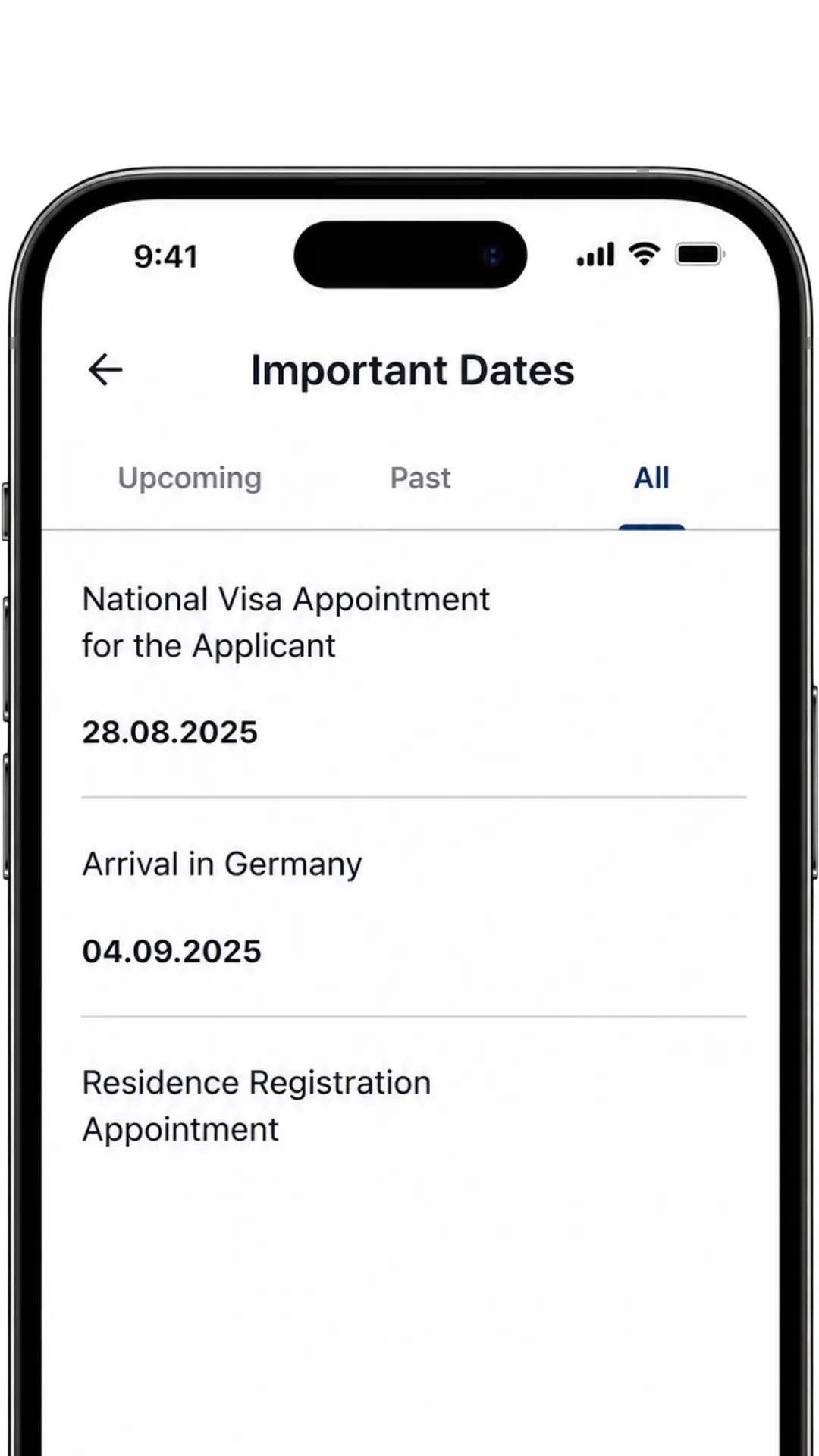
Download Our App!
Everything you need for relocating to Germany in one place: visa and document tracking, 24/7 chat with your personal manager, up-to-date adaptation tips, deadline reminders, and a personalized relocation plan — manage the entire process without calls or bureaucracy.