Leave your details and a comment
We'll contact you to arrange a convenient date and time.
EN
What to Consider Before Moving to Germany: 10 Essential Questions
Before starting a new life in Germany, there are several important things to think about: what documents you’ll need, how to find accommodation, and what to expect in terms of employment, healthcare, and everyday life.
In this guide, we’ve gathered the 10 most important questions to help you prepare for your move and settle into Germany with confidence.
How Do I Open a Bank Account?
Opening a German bank account (Girokonto) is one of the first things you should do after arriving. You’ll need it to receive your salary, pay rent, and manage your daily expenses.
Which Bank Should You Choose?
Traditional Banks
- Deutsche Bank
- Sparkasse
- Volksbank
- Postbank
These banks offer physical branches and personal consultations, although monthly account fees may apply.
Online Banks
- N26
- DKB
- Comdirect
Online banks usually provide lower fees, user-friendly mobile apps, and often free current accounts.
What Documents Will You Need?
✅ Passport or national ID card
✅ Proof of address (Meldebescheinigung)
✅ Employment contract
✅ German Tax Identification Number (Steuer-ID)
✅ If you’re self-employed or a freelancer: documents confirming your business status
Can Russian Citizens Still Open a Bank Account?
In recent years, opening a bank account in Germany has become more challenging for Russian citizens due to stricter banking regulations, international sanctions, and enhanced compliance checks.
However, it is still possible if you prepare the required documentation and choose a bank that accepts applications from Russian nationals.
Need help opening a German bank account without unnecessary delays or rejections? Contact us, and we’ll help you choose the best option for your situation.
2. Which Visa Do I Need?
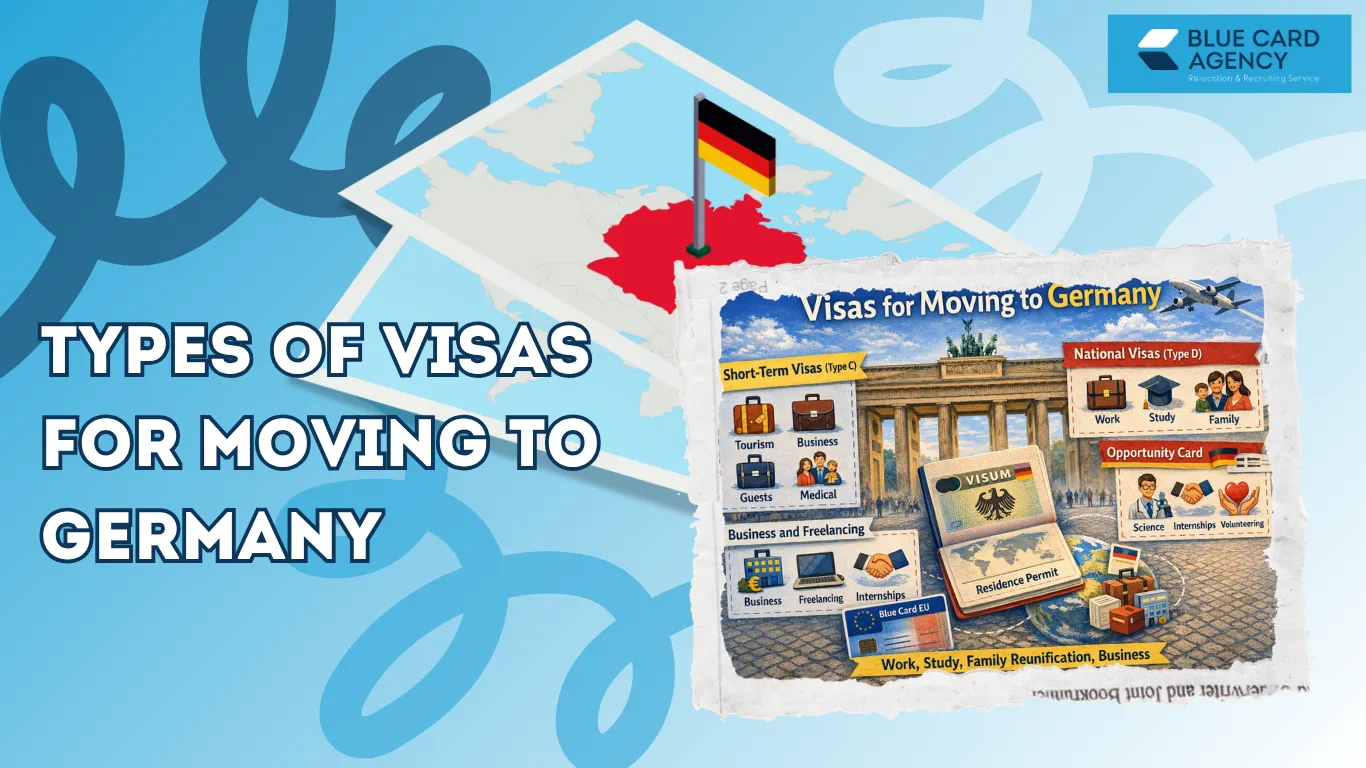
If you’re planning to stay in Germany for more than 90 days and you’re not an EU citizen, you’ll usually need a German National Visa (Type D). This visa allows you to enter Germany and later apply for a residence permit.
The right visa depends on the purpose of your stay.
Employment
- Employment visa
- EU Blue Card for highly qualified professionals
- Job Seeker Visa
- Freelancer or Self-Employment Visa
Education
- Student Visa
- Exchange Program Visa
- Language Course Visa
Family Reunification
- Joining your spouse
- Joining your parents or children
Other Reasons
- Long-term medical treatment
- Business or entrepreneurial activities
- Au Pair Visa
- Research Visa
- Volunteer Visa
Planning to Study or Work in Germany?
Not sure where to begin?
We’ve created step-by-step guides that explain the entire process—from applying to a German university and obtaining a student visa to finding a job and starting your career in Germany.
3. What Taxes Will I Pay in Germany?
Germany has a progressive tax system, meaning the amount of tax you pay depends on your income and your tax class (Steuerklasse).
Main Taxes
Income Tax (Einkommensteuer)
Income tax ranges from 14% to 45%, depending on your annual earnings.
Solidarity Surcharge (Solidaritätszuschlag)
Since 2021, this surcharge only applies to individuals with higher incomes.
Church Tax (Kirchensteuer)
If you are a registered member of a recognized religious community, you’ll pay an additional 8–9% of your income tax.
Social Security Contributions
Employees are required to contribute to Germany’s social security system, which covers:
- Pension insurance
- Health insurance
- Unemployment insurance
- Long-term care insurance
These contributions typically amount to 20–22% of your salary, with approximately half paid by your employer.
What’s New in 2025?
✅ The tax-free allowance has increased to €12,084, meaning income below this amount is not subject to income tax.
✅ Families with children can benefit from additional tax advantages, including Kindergeld and the Child Tax Allowance (Kinderfreibetrag).
✅ Self-employed professionals should consider trade tax (Gewerbesteuer) and may qualify for the Small Business Regulation (Kleinunternehmerregelung).
Choosing the right tax class is an important step, as it directly affects your monthly tax deductions and potential tax benefits.
Need help understanding the German tax system? Whether you’re choosing the right tax class, filing a tax return, or dealing with an unexpected tax payment (Nachzahlung), our experts are here to help.
4. How Do I Rent an Apartment in Germany?
Finding accommodation is one of the biggest challenges for newcomers. In 2025, demand remains high in major cities such as Berlin, Munich, Hamburg, and Frankfurt, with rental prices continuing to rise.
How to Rent an Apartment
✅ Start your search 2–3 months before your move whenever possible.
Prepare the Required Documents
- Passport or residence permit
- Employment contract (Arbeitsvertrag) or proof of income
- SCHUFA credit report
- Rental clearance certificate (Mietschuldenfreiheitsbescheinigung) from your previous landlord, if available
Be Prepared to Pay a Security Deposit
Most landlords require a security deposit (Kaution) equal to two or three months’ cold rent (Kaltmiete).
Consider Alternative Housing Options
If finding a private apartment is difficult, you may also consider:
- Shared accommodation (WG – Wohngemeinschaft)
- Public or subsidized housing programs, where available
Our comprehensive long-term rental guide will help you avoid common mistakes, speed up your apartment search, and find accommodation that matches both your budget and your needs.
Where to Search for Housing
- ImmoScout24
- Immowelt
- Kleinanzeigen (formerly eBay Kleinanzeigen)
- Facebook groups and Telegram communities
- Local real estate agents and property management companies (Hausverwaltung)
At Blue Card Agency, we offer a wide selection of rental apartments in cities including Berlin and Munich, with monthly rents ranging from €1,300 to €3,500 and lease terms from 3 to 12 months.
We’ll help you find accommodation that fits your preferences and budget, making your relocation to Germany as smooth and stress-free as possible.
5. How Can I Get a German Driver’s License?
After moving to Germany, your foreign driver’s license is generally valid for six months. After that, you’ll either need to exchange it for a German license or obtain a new one.
Who Needs to Exchange Their License?
- EU and EEA citizens can continue driving with their existing licenses without exchanging them.
- If your country has a bilateral agreement with Germany (such as the United States, Canada, or Japan), you may be able to exchange your license without taking driving tests.
- Drivers from many other countries, including Russia and Ukraine, are usually required to pass both the theoretical and practical driving exams.
Required Documents
To exchange or obtain a German driver’s license, you’ll typically need:
- Passport or residence permit
- Proof of registration (Anmeldung)
- Eye test certificate (Sehtest)
- First Aid course certificate (Erste-Hilfe-Kurs)
- Biometric passport photo
- Certified translation of your driver’s license (if required)
If your license cannot be exchanged directly, you’ll need to enroll in a driving school (Fahrschule) and pass both the theory exam (available in several languages, including Russian) and the practical driving test.
How Much Does It Cost?
Obtaining a German driver’s license typically costs between €2,100 and €4,400, depending on the driving school, the number of lessons required, and your location.
Need assistance exchanging your driver’s license? Book a consultation with our team, and we’ll connect you with the right specialist for your specific situation.
6. How Can I Find a Job in Germany?
Germany continues to experience a strong demand for qualified professionals, with more than 100,000 job vacancies available across industries such as IT, healthcare, engineering, and skilled trades.
Where to Search for Jobs
General Job Portals
- StepStone
- Indeed
- Monster
Industry-Specific Platforms
- Jobware (Management positions)
- Heise Jobs (IT)
- HotelJob (Hospitality)
- GastroJobs (Hospitality & Catering)
Job Aggregators
- Adzuna
- SimplyHired
Federal Employment Agency
The Federal Employment Agency (Bundesagentur für Arbeit) offers an official job portal with vacancies and employment services available in both German and English.
Company Career Pages
Many employers publish vacancies directly on their websites before advertising them elsewhere.
Professional Networks
Create profiles on LinkedIn and Xing to connect with recruiters and expand your professional network.
Recruitment Agencies
Recruitment agencies can be especially helpful if you’re looking for opportunities in healthcare, IT, engineering, or other high-demand sectors.
Download our step-by-step guide to finding a job in Germany. Learn how to prepare your application, succeed in interviews, obtain a work visa, and start your career with confidence.
7. Which Health Insurance Should I Choose?
Health insurance (Krankenversicherung) is mandatory for everyone living in Germany. Without valid health insurance, you cannot obtain a residence permit, start a job, or access most healthcare services.
Germany offers two main types of health insurance.
Statutory Health Insurance (GKV)
The public healthcare system is suitable for most employees, students, and pensioners.
- Contributions start at approximately 14.6% of your salary
- The minimum monthly contribution is around €200–250
- Employers usually pay half of the contribution
- Everyone receives the same level of basic medical care, regardless of income
Private Health Insurance (PKV)
Private insurance is generally available to:
- Freelancers
- Self-employed professionals
- High-income employees (annual income above €73,800 in 2025)
Private insurance offers greater flexibility and additional services, but premiums depend on your age, health, and selected coverage.
Good to Know
✅ Students and newcomers may qualify for discounted health insurance rates starting from around €120 per month.
✅ Professionals such as doctors, lawyers, and IT specialists often choose private insurance because it offers broader coverage and shorter waiting times.
Choosing the right health insurance is an important long-term financial decision. Comparing your options carefully can save you significant money while ensuring the level of medical care you need.
8. How Can I Study at a German University?
Germany is one of Europe’s most popular destinations for international students, offering more than 400 universities with programs taught in both German and English.
Types of Universities
Universities (Universität)
Ideal for academic research and theoretical education.
Universities of Applied Sciences (Fachhochschule)
Focused on practical training and close cooperation with industry.
Technical Universities (TU)
Specialized in engineering, technology, and natural sciences.
Admission Requirements
Admission deadlines vary by university, but most Bachelor’s programs require applications by:
- 15 July for the winter semester
- 15 January for the summer semester
International applicants usually need:
- A secondary school diploma
- One or two years of university education in their home country (for many education systems), or successful completion of a Studienkolleg, if required
- A complete application package, including educational documents and language certificates
Applications are typically submitted through uni-assist or directly to the university.
Tuition Fees
Most public universities in Germany do not charge tuition fees. Students usually pay only a semester contribution of approximately €200–400.
The main exception is the state of Baden-Württemberg, where most non-EU students pay tuition fees of approximately €1,500 per semester.
Our comprehensive study guide explains every step—from choosing a university and preparing your documents to diploma recognition and obtaining your German student visa.
9. What Social Benefits Can I Receive?
If you’re moving to Germany, you may be eligible for a range of social benefits depending on your residence status, employment, and income.
Child Benefit (Kindergeld)
Families with children are generally entitled to Kindergeld, regardless of nationality, provided they meet the legal requirements.
As of 2025, the benefit amounts to €255 per month per child.
Our detailed guide explains:
- which documents you’ll need,
- how to complete the application,
- where to apply,
- and how to avoid common delays.
Housing Benefit (Wohngeld)
If your income is not sufficient to cover your rent, you may qualify for Wohngeld (housing benefit).
The amount depends on:
- your income,
- household size,
- and rental costs.
In 2025, both eligibility and benefit amounts were expanded to help offset rising housing and energy costs.
Unemployment Benefits
Unemployment Benefit I (Arbeitslosengeld I)
If you’ve worked in Germany for at least 12 months and lose your job, you may receive 60–67% of your previous salary for a limited period.
Bürgergeld
Bürgergeld provides basic financial support for people with low income or those who are unemployed.
In 2025, the standard monthly payments are:
- €563 for adults
- €357–509 for children, depending on their age
Health Insurance Subsidies
Germany has two mandatory health insurance systems:
- Statutory Health Insurance (GKV)
- Private Health Insurance (PKV)
For individuals with lower incomes, the government may partially or fully cover statutory health insurance contributions.
If you qualify, you’ll need to submit an application through the Jobcenter or Sozialamt, together with proof of income and other supporting documents.
Student Benefits
Students may be eligible for:
- discounted public transportation,
- subsidized student housing,
- reduced health insurance premiums,
- and additional financial support, depending on their circumstances.
Applications are submitted to the relevant authorities, such as the Familienkasse for Child Benefit or the Jobcenter for social assistance.
Blue Card Agency can help you understand which benefits you may qualify for and guide you through the application process quickly and accurately.
10. How Can I Apply for Permanent Residence or German Citizenship?
If you plan to build your future in Germany, obtaining permanent residence or German citizenship is an important long-term goal.
Permanent Residence Permit (Niederlassungserlaubnis)
To qualify, you generally need to:
- Have legally lived in Germany for at least five years with a valid residence permit.
- Demonstrate a stable income sufficient to support yourself and your family without relying on public assistance. (Receiving Kindergeld does not affect eligibility.)
- Have German language skills at B1 level or higher.
- Show basic knowledge of Germany’s legal and social system.
- Have no serious criminal record.
- Maintain valid health insurance.
German Citizenship (Einbürgerung)
Germany’s citizenship law was significantly modernized in 2024, making naturalization easier for many applicants.
In most cases, you must:
- Have legally lived in Germany for at least five years.
- Demonstrate financial independence without relying on social assistance.
- Have German language skills at B1 level or above.
- Pass the German Citizenship Test (Einbürgerungstest).
Fast-Track Naturalization
You may become eligible after three years if you demonstrate exceptional integration, for example:
- German language proficiency at C1 level
- Volunteer work
- Outstanding professional or academic achievements
Dual Citizenship
Germany now generally allows dual or multiple citizenship, meaning applicants no longer have to give up their original nationality, provided their home country also permits dual citizenship.
How to Apply
Applications for permanent residence or citizenship are submitted to your local Foreigners’ Office (Ausländerbehörde) or, depending on your federal state, through an online application system.
After submitting your application, you’ll attend an interview and provide the required supporting documents.
Blue Card Agency — We’re Here to Help
Moving to Germany is a life-changing decision, and navigating immigration procedures can feel overwhelming. That’s why we’re here to support you every step of the way.
Our team has:
- conducted more than 2,000 consultations,
- successfully completed over 1,500 immigration cases,
- and brings together experts from seven specialized fields to help solve even the most complex relocation challenges.
We provide practical guides and step-by-step instructions to help you avoid costly mistakes when applying for visas, residence permits, citizenship, diploma recognition, and many other immigration procedures.
We also regularly share the latest immigration news, practical advice, and useful resources on our Telegram channel, helping you stay informed throughout your relocation journey.
Have questions about moving to Germany? Contact Blue Card Agency today and let our experts help you make your relocation as smooth and stress-free as possible.
Explore More
-
Finding Accommodation in Berlin and Anmeldung: A Complete Guide for…
-

How to Relocate from UAE and Gulf Countries to Germany:…
-
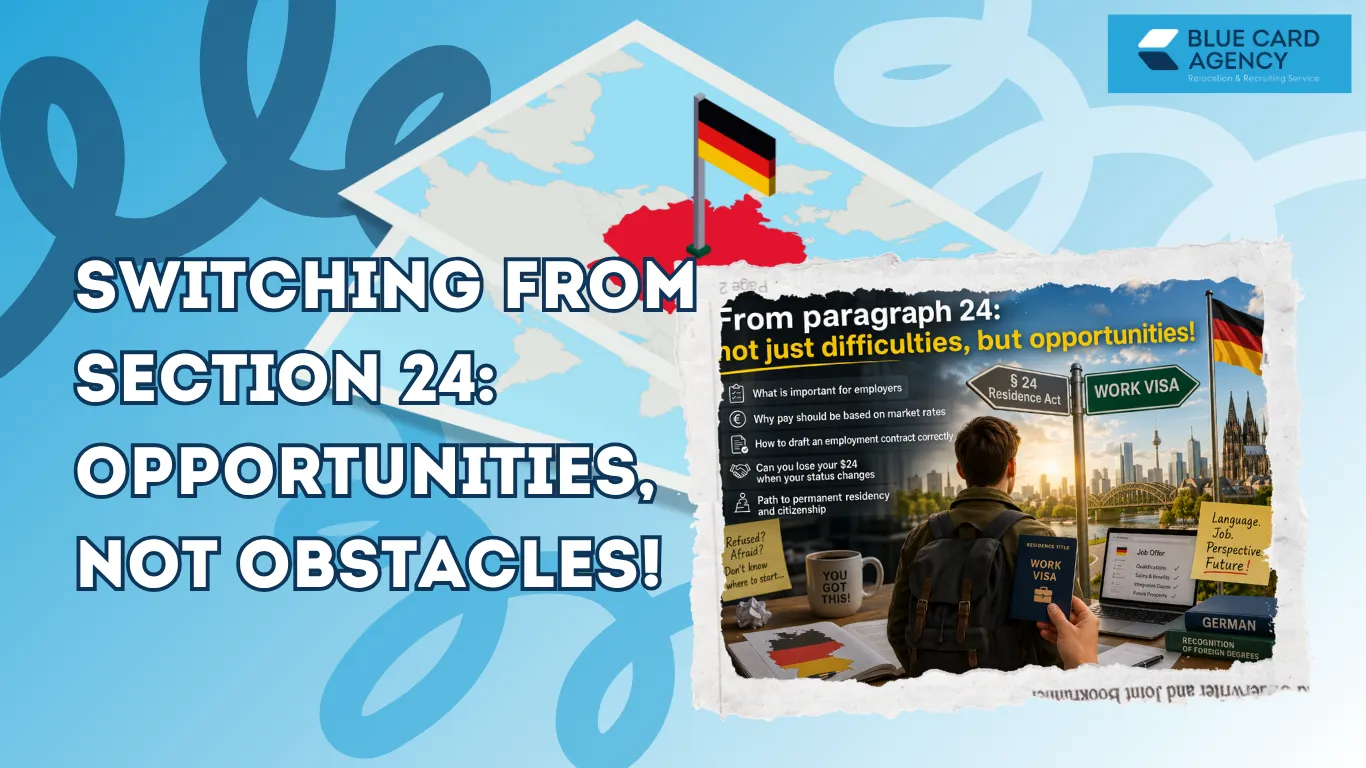
Switching from Section 24: Opportunities, Not Obstacles! Switching from Section…
-
-
-